Every quarter, Equifax Canada publishes the cleanest single read on Canadian household credit, and every quarter, most working professionals miss what it actually tells them. The Q1 2026 Market Pulse, released May 26, is the most actionable report of the year so far. Not because the headlines are dramatic. Because the regional concentration is so specific that it functions as a literal call list.
The Headline Numbers
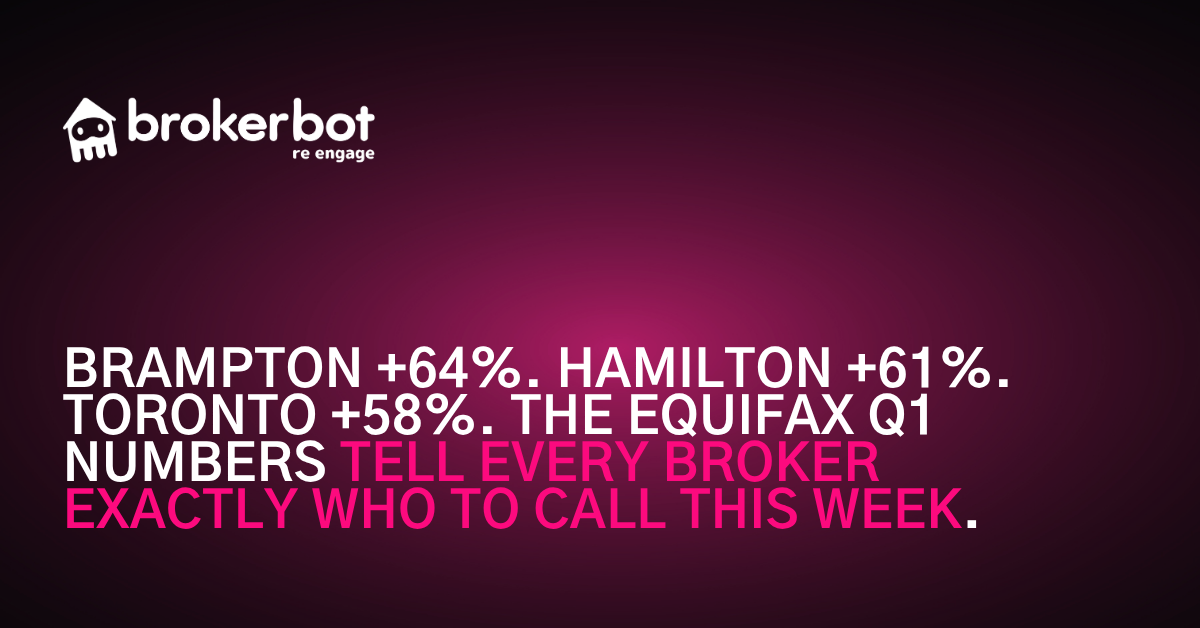
Equifax reported the national mortgage balance delinquency rate at 0.28% in Q1 2026, up 32% year-over-year and 5% quarter-over-quarter. The 90+ day volume rate stayed at 0.22%, still below pre-pandemic levels. The story is not the national average. The story is the regional concentration. Ontario mortgage delinquencies jumped 52% year-over-year. British Columbia delinquencies climbed 36%. Quebec and Saskatchewan saw decreases. Inside Ontario, the concentration tightens further: Brampton +64%, Hamilton +61%, Toronto +58%.
Homeowner insolvencies jumped 11% over Q4 2025 and 18.8% year-over-year, hitting the highest quarterly level since 2009. Over 90% of insolvent homeowners chose consumer proposals over bankruptcy. The average balance of delinquent mortgages rose to $355,500, up 13.2% year over year. The average non-mortgage debt held by mortgage holders who missed a payment is now $54,000, up 4.6% year-over-year.
What the Data Actually Means
Rebecca Oakes, Vice President of Advanced Analytics at Equifax Canada, gave Global News the single most useful sentence in the entire report: "Where we see those missed payments on the mortgage, it's a very high missed payment rate on everything else by that point." Translation: by the time a Canadian misses a mortgage payment, almost everything else in their financial life is already breaking. Mortgage delinquency is not the start of the trouble. It is the late-stage symptom.
Ron Butler of Butler Mortgage, speaking to CBC News, described the situation as a perfect storm: "When individuals face general unaffordability or experience job loss or underemployment, they previously had the option to tap into their home equity, which was available from 2009 until 2023. That option is no longer viable. Everyone who purchased homes from 2020 to 2022 is now facing properties worth significantly less than their purchase price in Ontario." The equity safety valve is closed. That is the regional concentration story in one paragraph.
Why This Matters for Mortgage Brokers
If you have any past clients in Brampton, Mississauga, Hamilton, Toronto, Vancouver, or Surrey who renewed in 2024 or 2025, they are statistically your highest-risk segment right now, and they need a phone call this week, not next quarter. The Equifax data gives you a credible third-party reason to reach out: there is real industry-wide stress; here is what is happening; here are your options; let us talk through your situation. The broker who makes that call holds the renewal and earns the referral. The broker who waits for the missed-payment letter loses the client to whichever competitor or bank handled the recovery conversation first.
As Kevin Dear, COO of BrokerBot, puts it: "The numbers Equifax just released are the renewal cliff arriving in real time. The average delinquent mortgage balance of $355,500 is up 13.2% year over year. That is real households on real streets. Brokers who systemize monthly homeowner touchpoints catch the at-risk client before the bank does. The ones who do not see the problem until a power-of-sale listing hits MLS."
Why This Matters for Real Estate Agents
The 905 belt is the agent story this quarter. Brampton and Hamilton lead the country on delinquency growth, with the 416 not far behind. Distressed listings risk is climbing through the summer. Agents who build a referral rhythm with a strong mortgage broker partner and an insurance partner create a lifeline for at-risk homeowners before the power-of-sale or court-ordered listing process starts. Rental conversion strategy belongs in every Q3 listing presentation in the 905 right now. The agents who already have the proactive renewal conversation infrastructure win the listings that emerge from this cycle. The ones who do not lose them to whoever picks up the phone first.
Why This Matters for Insurance Brokers
18.8% year-over-year growth in homeowner insolvencies is the strongest single argument for creditor protection products in this cycle. Every renewing mortgage client in your book or your referral network is a candidate for the conversation about what happens if a job loss, an injury, or an illness hits the household budget at exactly the wrong moment. Insurance brokers who plug into broker-agent referral ecosystems and proactively run the renewal-cycle conversation capture coverage moments that other channels miss entirely.
The Optimistic Story Hiding in the Data
It is easy to read the Equifax release and conclude the worst. The full picture is more nuanced. Younger consumers under 25 actually saw their first year-over-year improvement in delinquency since mid-2022. Quebec, Nova Scotia, Saskatchewan, and New Brunswick all showed measurable improvements. National non-mortgage debt actually fell by more than $487 million in Q1 as consumers paid down balances. Oakes herself noted: "This discipline enabled many Canadians to pay down balances during the first quarter, representing a critical shift in how consumers are navigating the current macroeconomic climate."
Translation: most Canadian households are absorbing the rate transition. The problem is geographic and vintage specific, which means it is also fixable for working professionals who know which clients to talk to first.
What to Do This Week
Three actions for every mortgage broker, agent, and insurance pro reading this. First, build the postal code call list. Any past client in Brampton, Mississauga, Hamilton, Toronto, Vancouver, or Surrey who renewed in 2024 or 2025 is included. Second, send each of them one paragraph this week. Here is what Equifax just reported. Here is what it means for your situation. Here are your options. Let us talk. Third, automate the consistency for the rest of your book so this work is already done the next time the data turns. 82% of homeowners want monthly home value updates. The professionals who deliver them are the ones who get the call before the missed-payment letter does. Top of mind beats top of Google every time.
FAQs
Q: What did the Equifax Q1 2026 Market Pulse actually find?
National mortgage balance delinquency rate at 0.28%, up 32% year-over-year. Ontario delinquencies +52%, BC +36%, Quebec and Saskatchewan declining. Inside Ontario: Brampton +64%, Hamilton +61%, Toronto +58%. Homeowner insolvencies +18.8% YoY, highest level since 2009. Average delinquent mortgage balance $355,500, +13.2% YoY. BrokerBot tracks every Canadian credit and property release with plain-language context so working professionals can have these conversations with clients without doing the research themselves.
Q: Is this the start of a mortgage crisis?
Not yet. The 90+ day volume delinquency rate is still 0.22%, below pre-pandemic levels. Ron Butler told CBC the rate is "manageable" for any bank. The story is geographic concentration in Ontario and BC, not a national systemic failure. But for working professionals in those regions, the data points to a specific group of clients who need proactive outreach now.
Q: Why is the concentration in Brampton, Hamilton, and Toronto?
Ron Butler attributes it to a combination of declining home values (which removed the equity safety valve for households facing job loss or underemployment), the renewal of low-rate vintage mortgages from 2020-2022 at much higher rates, and pockets of investor concentration where rental income models have struggled. Brampton specifically has been impacted by reductions in international student numbers, which have affected investor cash flow.
Q: Why does this matter to mortgage brokers?
Because Equifax has effectively published a list of where the at-risk clients live. Brokers with past clients in those postal codes have a credible reason to reach out this week, given the industry-wide context. The brokers who make that call hold the renewal. The ones who wait lose the client to whichever competitor handled the recovery.
Q: Why does this matter to real estate agents?
The 905 belt and Vancouver are entering a period where distressed listings could climb through the summer. Agents who pair with strong mortgage and insurance partners can create lifelines for at-risk homeowners (rental conversion, refinance strategy, payment matching) before the power-of-sale process starts. Agents already in proactive renewal conversations capture the listings that do emerge.
Q: Why does this matter to insurance brokers?
18.8% year-over-year growth in homeowner insolvencies is the cleanest single case for creditor protection products in this cycle. Every renewing client in your book or your referral network is a candidate for the conversation about what happens if a job loss, injury, or illness hits at the wrong moment.
Q: How can I stay on top of my client book between transactions?
Send your past clients monthly home value updates branded with your name. 82% of homeowners want them. BrokerBot automates the consistency through the OPTA/FCT data partnership so brokers, agents, and insurance pros stay visible between renewals without manual effort. The professionals who already have that infrastructure are the ones their clients call first when the data turns. Top of mind beats top of Google every time.
.png)
.png)
.png)
.svg)
.svg)
.svg)